
Welcome! This guide unlocks your Nikon D5200’s potential, offering a comprehensive overview of its features. Access the complete User Manual as a PDF, or explore the
Nikon Manual Viewer 2 application for convenient access to instructions.
Overview of the Camera
The Nikon D5200 is a versatile Digital Single-Lens Reflex (DSLR) camera designed for both beginners and enthusiasts. It boasts a 24.2-megapixel DX-format CMOS sensor, delivering high-resolution images with excellent detail and clarity. This camera provides a balance between image quality, features, and affordability, making it a popular choice for those stepping into the world of DSLR photography.
The D5200 features a 3.0-inch Vari-Angle LCD screen, allowing for comfortable viewing and shooting from various angles. It also includes a built-in flash and is compatible with Nikon’s extensive range of NIKKOR lenses. You can find detailed instructions within the User Manual (available as a PDF) regarding lens compatibility and settings.

Accessing the INDEX.pdf file on the included CD provides a quick start guide. Furthermore, the Nikon Manual Viewer 2 application, downloadable from app stores, offers a digital version of the manual for convenient on-the-go reference. Understanding the camera’s capabilities begins with exploring its documentation.
Key Features and Specifications
The Nikon D5200 showcases several key features. Its 24.2MP DX-format CMOS sensor delivers exceptional image quality, while the EXPEED 3 image processor ensures fast performance and reduced noise. It offers a sensitivity range of ISO 100-6400, expandable to ISO 25600, for shooting in various lighting conditions.

Key specifications include a 3.0-inch tilting LCD screen with 921k-dot resolution, a 51-point autofocus system for precise subject tracking, and continuous shooting at up to 5 frames per second. Full HD 1080p video recording capabilities are also present. Refer to the User Manual, downloadable as a PDF, for detailed explanations of these features.
The camera supports SD/SDHC/SDXC memory cards. The Nikon Manual Viewer 2 application provides a digital version of the manual, offering easy access to specifications and operational instructions. Latitude, longitude, and altitude data are also recorded. Detailed flash usage is explained in the Speedlight manual.

Getting Started
Begin your journey! Unbox your Nikon D5200, install the software from the included CD (or download it), and familiarize yourself with the camera’s controls using the manual.
Unboxing and Initial Setup
Welcome to the Nikon D5200 experience! Upon opening the box, carefully verify all included components. You should find the D5200 camera body, a standard 18-55mm VR lens (depending on the kit purchased), a battery, battery charger, power cable, USB cable, and crucial documentation – including the User Manual in PDF format on the included CD.
Before first use, fully charge the battery using the provided charger. While charging, insert the CD into your computer. Double-click the “Nikon D5200” icon to access the contents. Locate and double-click the “INDEX.pdf” icon to view the comprehensive digital manual.

Next, insert the battery into the camera and a compatible memory card (SD card recommended). Power on the camera and follow the on-screen prompts to set the language, date, and time. This initial setup is vital for optimal camera operation. Refer to the manual for detailed illustrations and troubleshooting tips if needed. Ensure the lens is securely attached before proceeding.
Installing the Nikon D5200 Software
To fully utilize your Nikon D5200’s capabilities, installing the accompanying software is essential. Begin by inserting the provided CD into your computer. On Windows, double-click the “Nikon D5200” icon in “Computer” or “My Computer.” On Macintosh, double-click the icon on your desktop.
The installation process will guide you through installing several key components, including Nikon Transfer 2 for image transfer, ViewNX-i for image viewing and editing, and potentially other utilities. Follow the on-screen instructions carefully, accepting license agreements as prompted.
Alternatively, you can download the latest software versions directly from the Nikon website, ensuring compatibility with your operating system. The User Manual (available as a PDF on the CD and online) provides detailed steps and troubleshooting advice. Consider also downloading the Nikon Manual Viewer 2 application for mobile access to your camera’s documentation. Successful installation unlocks advanced features and streamlined workflow.
Understanding the Camera’s Buttons and Controls
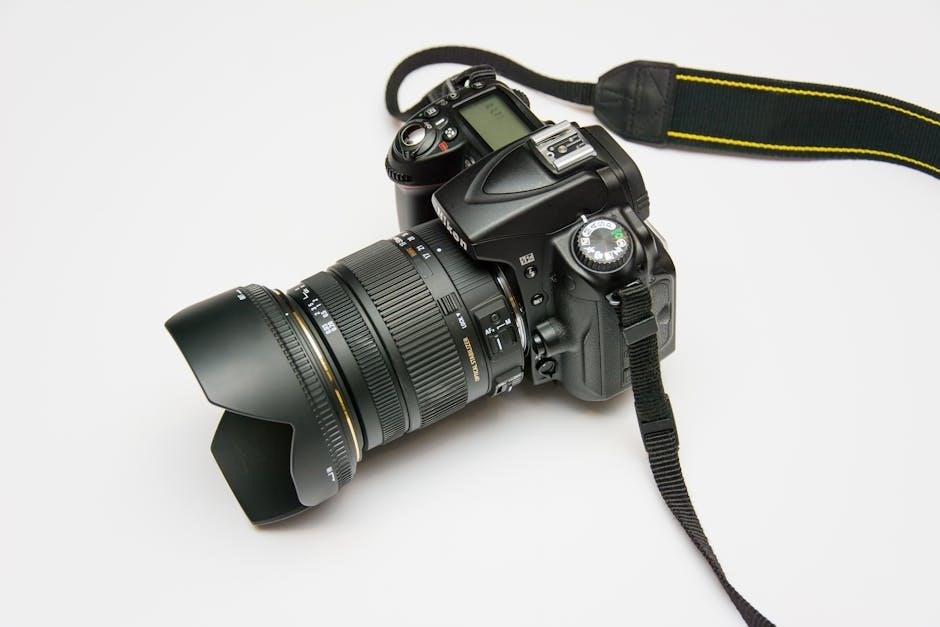
Familiarizing yourself with the Nikon D5200’s buttons and controls is crucial for efficient operation. The top panel houses the mode dial, allowing selection of Auto, Scene, and advanced shooting modes; The shutter button initiates image capture, while the control dial adjusts settings like aperture and shutter speed in manual modes.
On the rear, the directional pad navigates menus and selects focus points. The ‘i’ button provides quick access to frequently used settings. The Live View button activates Live View shooting, and the video record button starts and stops video recording; The menu button opens the camera’s comprehensive settings menu.
Refer to the User Manual (available as a PDF) for a detailed diagram and explanation of each control. The Nikon Manual Viewer 2 app offers convenient mobile access to this information. Mastering these controls unlocks the full creative potential of your D5200.

Basic Operation
Start shooting! Utilize Auto and Scene modes for simplicity, or explore manual controls. The PDF User Manual details focusing techniques and exposure settings for optimal results.
Shooting Modes: Auto and Scene Modes
Effortless Photography: The Nikon D5200 simplifies image capture with its versatile shooting modes. Auto Mode intelligently analyzes the scene, selecting optimal settings for exposure, focus, and white balance – perfect for beginners or quick snapshots. For more control, explore the Scene Modes.

Scene Mode Selection: These pre-configured settings cater to specific shooting situations. Choose from options like Portrait (for blurred backgrounds and flattering skin tones), Landscape (for sharp detail and vibrant colors), Close-up (for macro photography), Sports (for freezing action), and Night Portrait (for capturing subjects with a blurred background in low light).
Understanding Scene Modes: Each Scene Mode optimizes camera settings for the intended subject. Refer to the User Manual (PDF) for detailed explanations of each mode and when to use them. Experimenting with these modes allows you to achieve professional-looking results without needing extensive photographic knowledge. The manual provides guidance on maximizing each mode’s potential.
Focusing Modes and Techniques
Achieving Sharp Images: The Nikon D5200 offers several focusing modes to ensure your subjects are crisp and clear. Auto-area AF automatically selects focus points across the frame, ideal for general photography. Single-point AF allows precise focus point selection, perfect for stationary subjects requiring pinpoint accuracy.
Dynamic-area AF is excellent for tracking moving subjects; you select a focus point, and the camera adjusts as the subject moves. 3D-tracking locks onto a subject and continues to track it even as it moves across the frame. Consult the User Manual (PDF) for detailed explanations of each mode.
Focus Lock Technique: Press the shutter button halfway to lock focus on your subject, then recompose the shot while holding the button. This is useful when your desired focus point isn’t directly under the active focus point. Mastering these techniques, detailed in the manual, will significantly improve your image quality.
Understanding Exposure: Aperture, Shutter Speed, and ISO
Mastering Exposure: Exposure is the amount of light reaching the camera sensor, controlled by aperture, shutter speed, and ISO. Aperture (f-stop) controls the lens opening, affecting depth of field – a wider aperture (lower f-number) creates a shallow depth of field, blurring the background.
Shutter speed determines how long the sensor is exposed to light; faster speeds freeze motion, while slower speeds allow more light in but can cause blur. ISO measures the sensor’s sensitivity to light; higher ISOs are useful in low light but can introduce noise.
The Nikon D5200’s User Manual (PDF) provides in-depth explanations of the exposure triangle. Experimenting with these settings, guided by the manual, is crucial for achieving properly exposed and creatively compelling photographs. Understanding their interplay unlocks full creative control.

Advanced Features
Explore further! The Nikon D5200 offers lens compatibility details, flash options, and extensive menu customization. Refer to the Reference Manual (PDF) for detailed instructions.
Working with Lenses: Compatibility and Settings
Lens versatility is key! The Nikon D5200 utilizes the Nikon F mount, offering broad compatibility with a vast range of Nikkor lenses – both older and newer designs. This includes DX-format lenses specifically designed for APS-C sensors like the D5200’s, and FX-format lenses which will provide a narrower field of view due to the sensor size difference.
When using FX lenses, the camera automatically applies a 1.5x crop factor. Understanding lens specifications is crucial; the manual details compatible lens types and any potential limitations. Pay attention to VR (Vibration Reduction) lenses, which help minimize camera shake, especially in low light.
Within the camera’s menu, you can access settings related to lens distortion correction and peripheral illumination correction. These features can automatically improve image quality, particularly with certain lenses. The Reference Manual (PDF) provides in-depth explanations of these settings and how they impact your images. Always ensure your lens is securely mounted and the aperture ring (if present) is set correctly before shooting.
Using the Built-in Flash and External Speedlights
Illuminating your shots! The Nikon D5200 features a built-in flash, useful for adding light in dimly lit situations or balancing harsh sunlight. Access flash settings through the camera’s menu, controlling modes like Auto, Red-Eye Reduction, Fill-Flash, and Manual. The manual details each mode’s function and optimal usage.
For more advanced lighting control, consider using Nikon Speedlights – external flash units. The D5200 supports Nikon’s Creative Lighting System (CLS), enabling wireless flash control. Refer to the Speedlight manual for detailed instructions on CLS setup and operation.
Menu options allow you to adjust flash compensation, high-speed sync, and rear-curtain sync when using external flashes. Understanding these settings unlocks creative possibilities. The Reference Manual (PDF) provides comprehensive guidance on flash synchronization and troubleshooting. Remember to properly mount Speedlights and ensure secure connections for optimal performance.
Customizing Camera Settings: Menu Navigation
Personalize your experience! The Nikon D5200’s menu system allows extensive customization. Access it via the menu button on the camera’s back. The menu is divided into several tabs: Shooting, Display, Setup, and others. Each tab contains numerous settings to tailor the camera to your preferences.
To navigate, use the directional pad and press OK to select. The User Manual (booklet) and Reference Manual (PDF) detail each setting’s function. Explore options like image quality, ISO range, autofocus settings, and custom functions. Don’t hesitate to experiment!
The INDEX.pdf file on the installation CD provides a quick reference to menu locations. Remember settings can be reset to defaults via the Setup menu if needed. The Nikon Manual Viewer 2 application offers digital access to these settings explanations on your mobile device, enhancing convenience.

Resources and Support
Need help? Download the complete User Manual (PDF), utilize the Nikon Manual Viewer 2 application, or consult online resources for troubleshooting common issues.
Downloading the Complete User Manual (PDF)
Accessing the comprehensive Nikon D5200 User Manual in PDF format is straightforward. The documentation for your camera consists of this booklet and a detailed Reference Manual available as a downloadable PDF file. To fully utilize your camera’s capabilities, reviewing both resources is highly recommended.
You can find the PDF manual through various online sources, including the Internet Archive, where multiple versions are available for download – including single-page processed JP2 ZIP and TORRENT options. Simply search for “Nikon D5200 Manual PDF” to locate reliable download links.
Alternatively, the manual was originally distributed on a CD (labeled “Nikon D5200”). Double-clicking the CD icon on your computer (Windows or Macintosh) and then selecting the “INDEX.pdf” icon will display the manual. Ensure you have a PDF reader installed to view the document correctly. This provides a complete guide to all features and functions of your Nikon D5200.
Nikon Manual Viewer 2 Application
Enhance your learning experience with the Nikon Manual Viewer 2 application, a convenient digital resource for your Nikon D5200. This free application, available for iPhone, iPad, and iPod touch devices, provides easy access to your camera’s manuals directly on your mobile device.
Download Nikon Manual Viewer 2 from the App Store or Google Play to have the complete documentation at your fingertips. This eliminates the need to carry a physical manual or search for PDF files on your computer. The application offers a user-friendly interface for browsing and searching through the manual’s contents.
With Nikon Manual Viewer 2, you can quickly find answers to your questions, learn about specific features, and troubleshoot issues while on the go. It’s a valuable tool for both beginners and experienced photographers looking to maximize their Nikon D5200’s potential. PDF files can also be viewed using a free program.
Troubleshooting Common Issues
Encountering difficulties with your Nikon D5200? This section addresses frequently asked questions and provides solutions to common problems. Refer to the comprehensive User Manual (available as a PDF) for detailed guidance and diagrams.
If experiencing flash-related issues, consult the dedicated Speedlight manual for specific instructions. Ensure proper lens compatibility and settings when encountering image quality concerns. For software installation problems, revisit the initial setup instructions and verify system requirements.
Should your camera fail to recognize a memory card, try reformatting it or using a different card. If the display appears dim, adjust the brightness settings. Remember to regularly check Nikon’s support website for updated FAQs and troubleshooting tips. Utilizing the Nikon Manual Viewer 2 application can also provide quick access to solutions.